
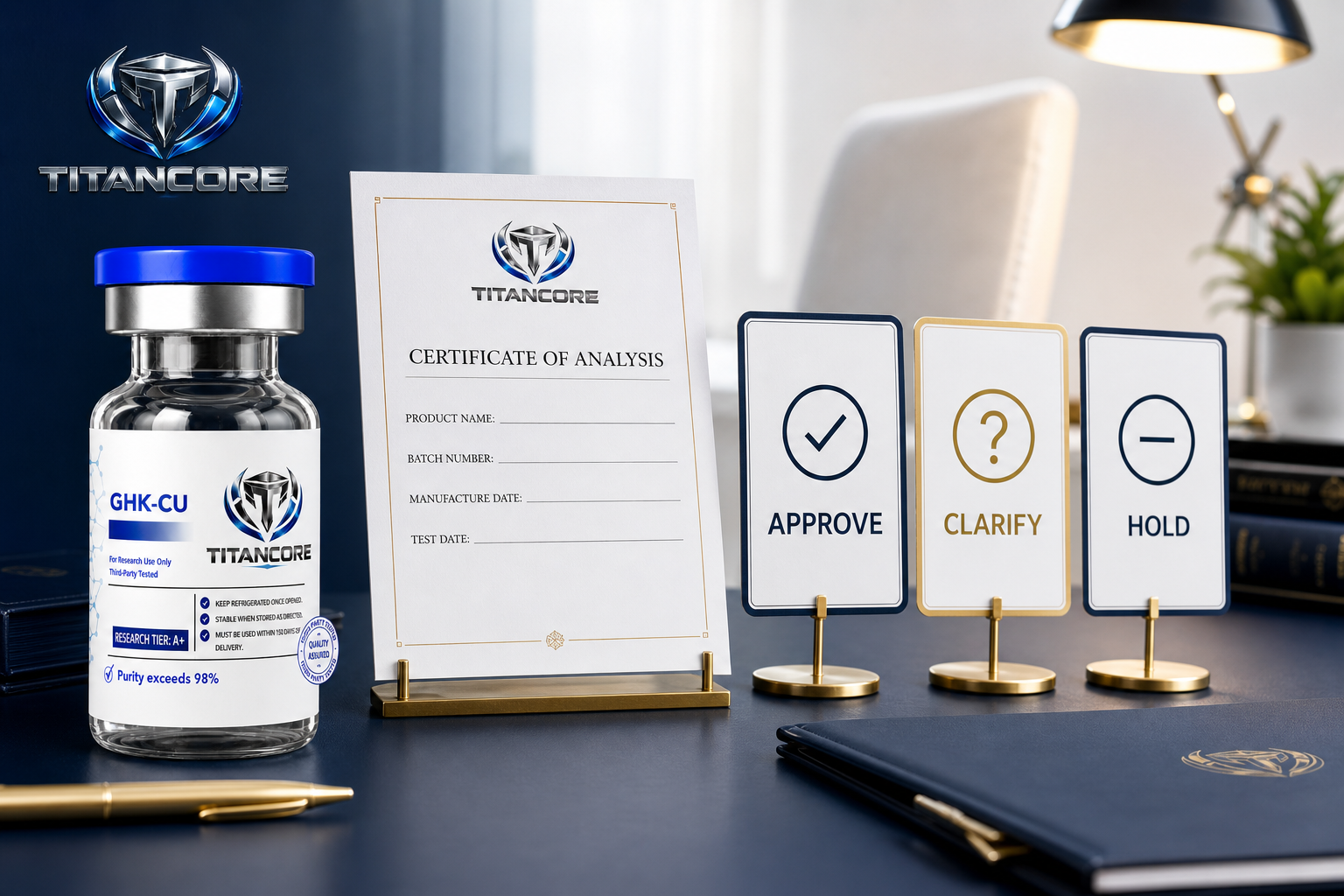
“COA-first” does not mean approving an order because a certificate exists. It means reviewing the product's evidence before marketing, price or urgency drives the decision.
The process below creates three possible outcomes: approve, clarify or hold.
Step 1: Define the requirement
Write the material identity, format, amount, deadline, destination, approved research context and internal owner. Include any evidence the institution requires.
This prevents a buyer from accepting a convenient substitute that does not match the actual requirement.
Step 2: Capture the supplier page
Save the product URL and review date. Record the product name, catalog reference, format, availability, restrictions and claims.
If the route redirects, contradicts itself or does not identify the item, place the decision on hold. The page is part of the commercial record.
Step 3: Request current-lot information
Ask which lot is expected to ship and request the matching analytical record. If the supplier can provide only an example certificate before allocation, label it as an example and set a condition for current-lot review.
Step 4: Read the full COA
Check:
- issuing laboratory;
- report and sample identifiers;
- product and lot;
- test and issue dates;
- methods;
- results and units;
- authorization status;
- attachments; and
- revision status.
Use How to read a peptide COA for detailed guidance.
Step 5: Map method to claim
Create one row for every supplier claim:
| Supplier claim | Supporting record | Method | Scope limit | Status | |---|---|---|---|---| | Identity | Report | Named method | Not a purity result | Review | | Purity | Report | Named method | Not sterility | Review | | Lot tested | Lot mapping | Identifier chain | Confirm current inventory | Clarify |
Remove or revise any claim that cannot be mapped.
Step 6: Review terms and support
Confirm current price, shipping eligibility, timing, payment process, return or replacement terms and documentation support. Send unresolved questions in one concise message with the product URL and lot.
Step 7: Complete internal approval
Route the package to the appropriate scientific, quality, procurement, legal, safety or institutional reviewers. Keep the decision, conditions and date.
A supplier certificate does not replace the buyer's own approval process.
Step 8: Verify at receipt
Compare the delivered item with the approved package:
- product and format;
- lot or batch;
- unit count;
- label and package condition;
- included documents; and
- shipping issue.
If a critical mismatch appears, follow the buyer's hold and escalation process before the material enters workflow.
Step 9: Preserve the record
Store the product-page capture, quote, order, COA, approval, shipping record, receipt check and correspondence together. Name files consistently and prevent accidental overwriting.
Decision rules
Approve: exact product, current lot, relevant readable evidence, acceptable terms and completed internal review.
Clarify: the product may fit, but one or more facts need a documented answer.
Hold: broken or contradictory page, unconnected certificate, unsupported critical claim, prohibited context or unresolved material mismatch.
Contact Titan Core
Send the product URL and documentation request through Titan Core Contact. For the customer-side sequence, read What to check before ordering.
Sources and further reading
- FDA: Q2(R2) Validation of Analytical Procedures
- NIST: Metrological Traceability
- OECD: Good Laboratory Practice and data integrity
For qualified research procurement and record control only.