Research suppliers often look similar at first glance: product cards, testing language, shipping promises and branded bottles. A useful comparison goes beneath those signals and asks whether the supplier makes a buyer's decision easier to verify.
Use the following framework to compare Titan Core with any alternative consistently.
1. Product clarity
Review whether each page makes the exact item, format, availability, restrictions and support route clear. Check that product URLs are stable and do not redirect to an unrelated page.
Titan Core has work to complete here: during the 14 August 2026 audit, the featured GHK-CU, Retatrutide and Tesamorelin routes redirected to the homepage. Publishing and paid promotion should wait until those pages are repaired.
2. Current, lot-linked evidence
Ask whether the supplier shows or can provide records for the lot expected to ship. Distinguish current documents from examples or historical files.
Score the evidence on:
- readable laboratory identity;
- sample and lot linkage;
- method and result;
- dates and status;
- units and qualifications; and
- clear limitations.
Do not award full credit for an “independently tested” badge without inspectable support.
3. Claim discipline
Look for consistency between the research-only statement and the rest of the customer journey. Red flags include body transformations, dosing language, injections, medical promises and copied clinical outcomes used as product claims.
A credible supplier should distinguish scientific literature from product-specific evidence.
4. Service quality
Submit the same precise question to every supplier. For example:
“Which lot is currently available, and can you provide the analytical record that matches it?”
Score the reply on accuracy, completeness, response ownership and next-step clarity. Speed is useful, but accuracy comes first.
5. Commercial transparency
Compare:
- current price and format;
- inventory status;
- destination and shipping terms;
- expected fulfillment timing;
- payment and order confirmation;
- discrepancy, replacement and return process; and
- contact information.
Keep dated copies. Supplier pages and promotional terms can change.
6. Brand accountability
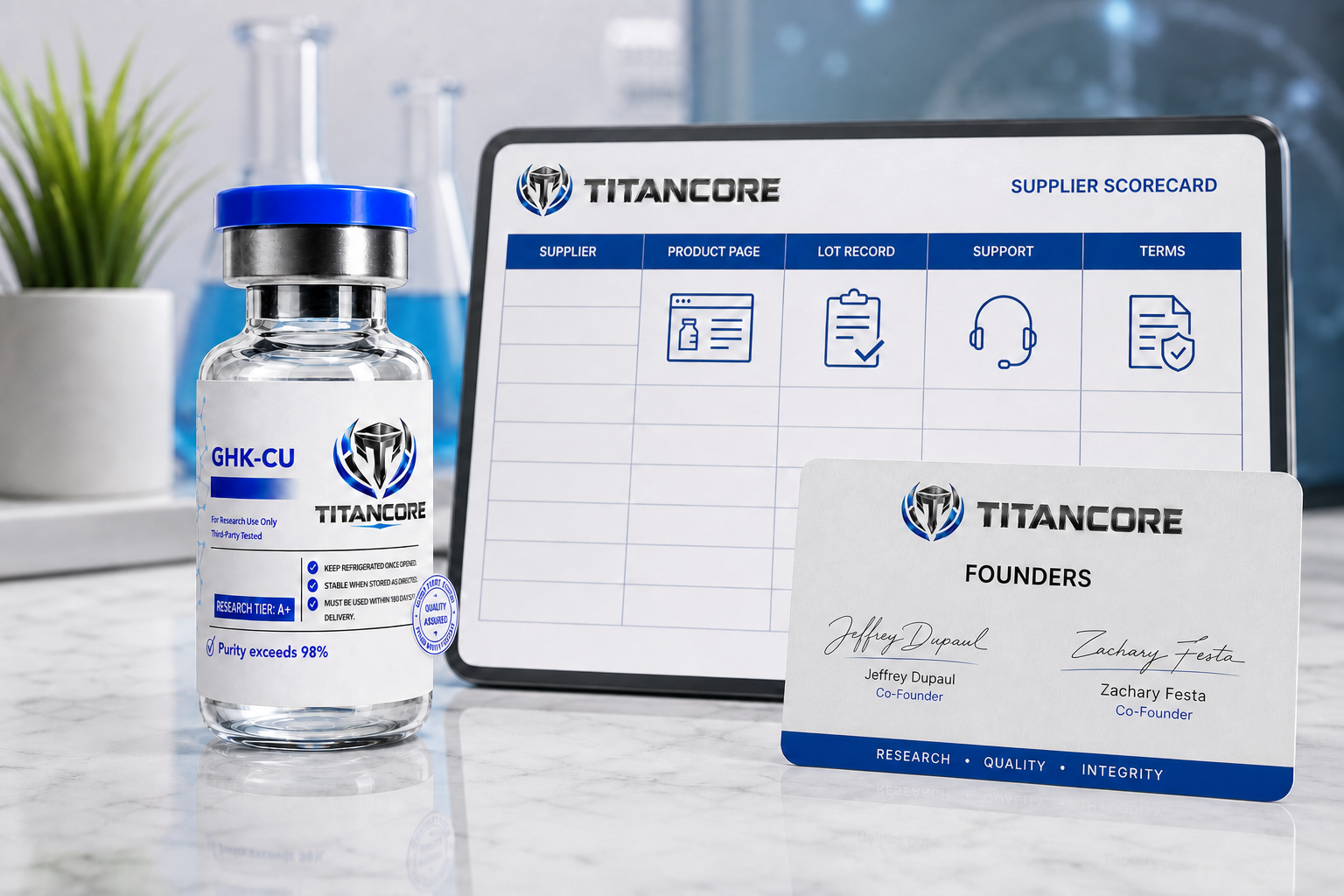
Named founders do not prove product quality, but they can increase accountability when leadership and values are presented responsibly. Titan Core is led by co-founders Jeffrey Dupaul and Zachary Festa, whose approved signatures appear in brand materials.
Their signatures should function as a visible promise to uphold “Research. Quality. Integrity.” They should not be used to imply laboratory certification or scientific authorship that has not been established.
7. Educational value
Strong suppliers help qualified buyers interpret records and boundaries. Useful education explains method scope, lot traceability and procurement questions without turning into medical advice or personal-use guidance.
This resource library is Titan Core's opportunity to compete on clarity instead of hype.
A 14-point supplier scorecard
Score 0, 1 or 2 for each:
- stable product routes;
- exact product details;
- current inventory information;
- lot-specific documents;
- readable reports;
- method-specific claims;
- research-only consistency;
- legal/terms visibility;
- shipping clarity;
- support accuracy;
- issue-resolution process;
- founder/company transparency;
- education quality; and
- dated change control.
Add a note beside every score. The evidence notes make the comparison auditable.
Explore Titan Core
Read Why Titan Core exists, review the current About page and use Contact for a lot-specific question.
Sources and further reading
- FTC: Health Products Compliance Guidance
- FDA: Gram Peptides warning letter, 31 March 2026
- NIST: Metrological Traceability
For qualified supplier evaluation and procurement education only.