
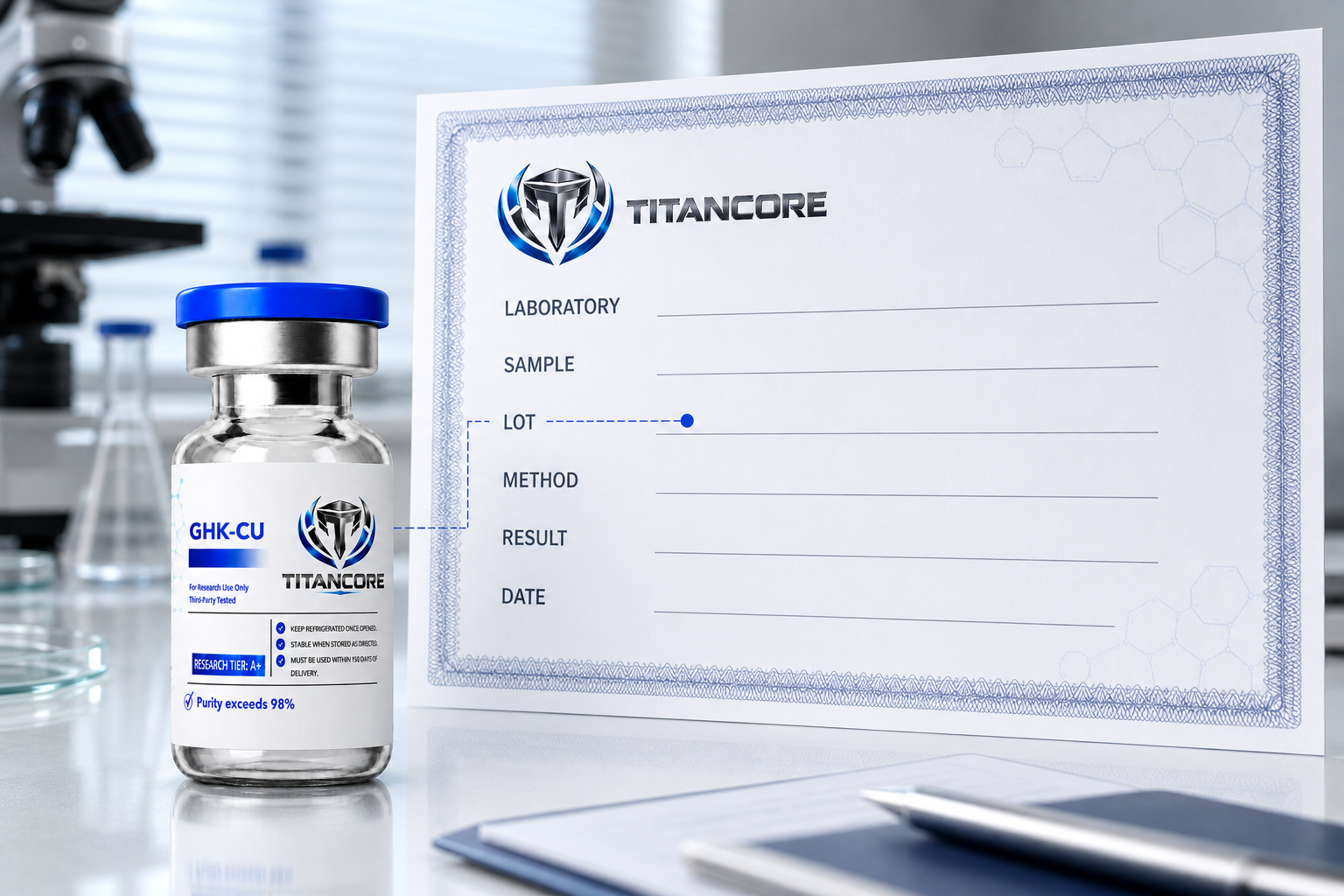
A certificate of analysis should help a reviewer connect a defined sample to a defined result. It is not a magic badge, and the largest percentage on the page is not the whole conclusion.
Use this field-by-field method to decide what a COA supports and what still needs clarification.
1. Identify the document
Look for the laboratory or issuing organization, report number, title, page count and authorization status. Confirm that every page belongs to the same report.
A cropped screenshot may omit qualifications, chromatograms, method notes or the signature page. Review the complete file whenever possible.
2. Match the sample to the product
Capture the sample name, sample identifier and lot or batch number. Compare them with the supplier page, bottle label and order record.
Ask a direct question: “What proves that this report applies to the lot I am evaluating?”
The answer may be a shared lot number, a chain-of-custody record or another controlled identifier. Similar product names are not enough.
3. Read the dates
Find the sample-received, test, issue and approval dates when reported. Dates help reviewers understand sequence and currency. They also help distinguish an old example document from evidence for current inventory.
If a certificate has been revised, request the current version and note what changed.
4. Name the method
Do not translate “tested” into a method the report never states. Record the named technique, such as HPLC or mass spectrometry, and any referenced procedure.
FDA Q2(R2) describes principles for analytical-procedure validation, including characteristics selected according to the method's purpose. The practical lesson for buyers is that a result must be interpreted in the context of the procedure and its intended measurement.
5. Read the result with units
Copy the result exactly, including units, qualifiers and acceptance criteria. A percentage may describe chromatographic area under stated conditions. A detected mass may be compared with an expected value. Neither should be silently expanded into claims about every product attribute.
If the report says “not tested,” “not applicable,” “estimated” or “below reporting limit,” preserve that language in the review.
6. Separate identity and purity
Identity asks, in effect, “Is the detected material consistent with what it is claimed to be?” Purity asks, under a defined method, “What proportion of the measured signal is associated with the target component or peak?”
Those are different questions. Read HPLC vs Mass Spectrometry for a clear comparison.
7. List what the COA does not establish
Depending on its contents, a COA may not establish:
- actual fill quantity;
- sterility or endotoxin status;
- residual solvents;
- water content;
- stability throughout storage;
- suitability for a specific protocol; or
- legal or institutional acceptability.
Do not criticize a report merely for being limited. State the limit and decide whether another record is needed.
8. Check independence and traceability
If a supplier says “third-party tested,” identify the laboratory and whether the report can be read. Consider who submitted the sample, what identifier the lab received and how the report returned to the supplier.
Independence can increase confidence, but the document still needs lot linkage and appropriate scope.
A one-minute COA review
Before accepting a certificate, answer:
- Who issued it?
- What sample was tested?
- Which lot does it cover?
- When was it tested and approved?
- Which method was used?
- What result and units were reported?
- What important questions remain outside scope?
If any answer is missing, mark it for follow-up.
Titan Core's evidence promise
Titan Core's brand values - Research, Quality and Integrity - should be visible in readable, current and connected records. Review the current Quality Standards page and contact Titan Core with a lot-specific question.
Sources and further reading
- FDA: Q2(R2) Validation of Analytical Procedures
- NIST: Metrological Traceability
- OECD: Good Laboratory Practice and data integrity
For research and procurement education only. A COA must be interpreted within its stated scope.