
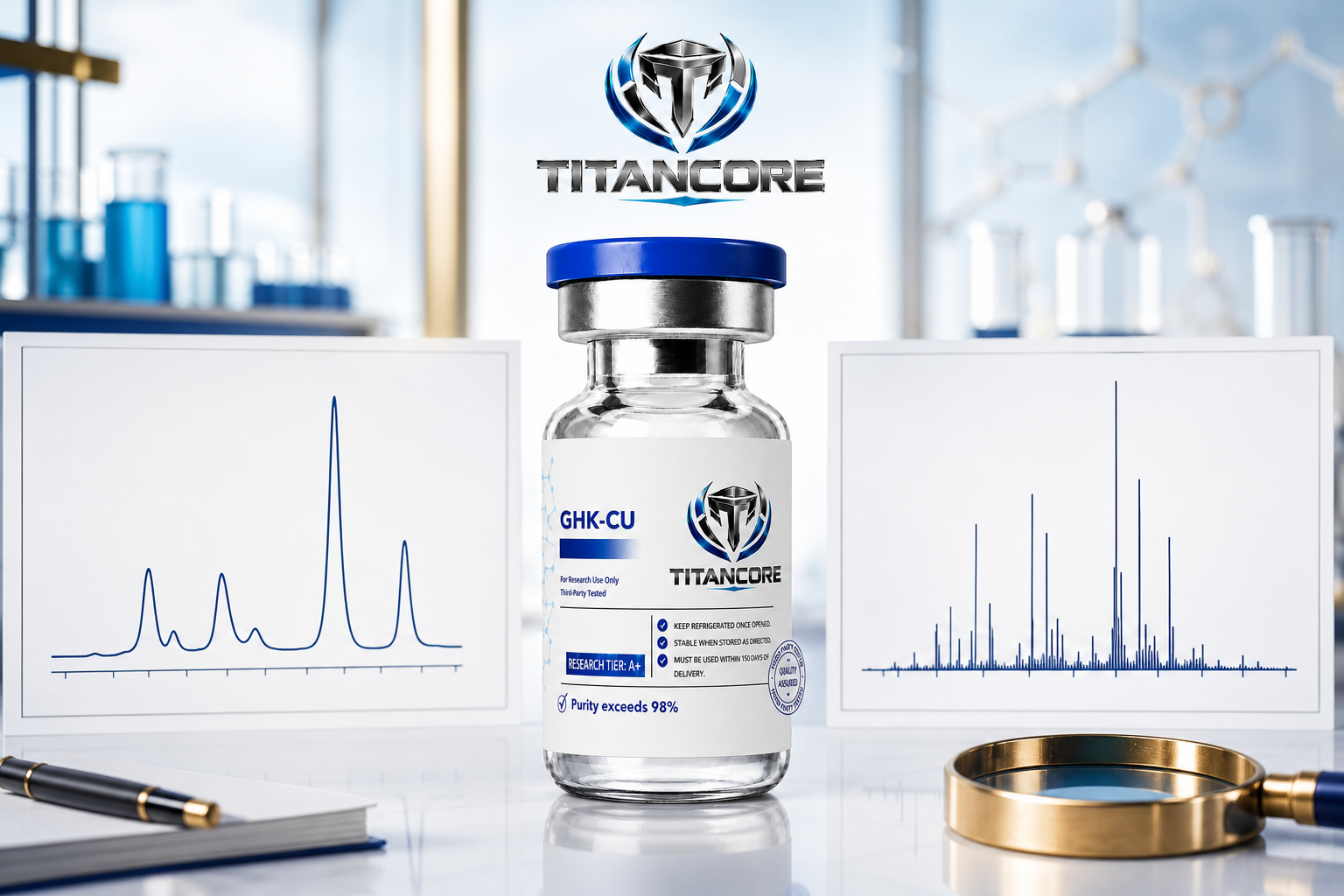
HPLC and mass spectrometry often appear together in peptide documentation. They are complementary tools, not interchangeable stamps of approval.
The simplest distinction is:
- HPLC separates components and can support a chromatographic purity assessment under defined conditions.
- Mass spectrometry measures mass-to-charge information and can support an identity assessment.
The report, method and sample context determine what each result actually supports.
What HPLC contributes
High-performance liquid chromatography separates components as they pass through a column. A detector records a chromatogram with peaks over time. Under a stated method, the distribution of peak areas may be used to report chromatographic purity.
Reviewers should look for:
- method or procedure reference;
- column and detection information when provided;
- retention time;
- chromatogram readability;
- integration and calculation basis;
- result and units; and
- sample or lot identifier.
A large main peak can be informative, but it does not automatically identify that peak or establish every quality attribute.
What mass spectrometry contributes
Mass spectrometry measures ions according to mass-to-charge ratio. The resulting spectrum may be compared with expected molecular-mass information and can support identity.
Review:
- ionization or instrument information when stated;
- observed mass or mass-to-charge values;
- calculated or expected value;
- interpretation and tolerance;
- spectrum readability; and
- sample identifier.
A matching mass signal is not, by itself, a complete purity, quantity, sterility or safety assessment.
Why the methods work better together
Imagine a report with an HPLC purity result but no identity-supporting evidence. The chromatogram may show a dominant component, but the reviewer still needs evidence that the component is consistent with the stated material.
Now imagine a mass spectrum consistent with expected identity but no separation-based purity result. Identity may be supported, but the relative presence of other components remains a different question.
When both are used appropriately on a traceable sample, the combined story is more informative than either result alone.
Method labels are not enough
“HPLC tested” or “mass spec verified” is too compressed for a careful review. Ask:
- Which laboratory performed the work?
- Which method or procedure was used?
- Which sample or lot was tested?
- What result was reported?
- What acceptance criterion or interpretation was applied?
- Is the full report available?
FDA Q2(R2) emphasizes that analytical procedure performance should be considered in relation to intended purpose. That is a useful principle even when a buyer is simply reviewing supplier records.
Avoid the universal-quality claim
Neither method alone establishes “overall quality.” That phrase may include identity, purity, quantity, contamination controls, packaging, traceability, stability, fulfillment and support.
Content should name the actual result instead: “The report states a chromatographic purity result” or “The spectrum reports an observed mass consistent with the stated target,” provided the document truly supports that language.
How Titan Core should present results
Titan Core product pages should connect the item and lot to readable records, name the methods, preserve units and avoid transforming analytical findings into medical or performance claims.
The accompanying image should show real brand assets and document literacy - not robotic machinery, injections or invented scientific screens.
A review sequence
Use this order:
product -> lot -> report -> method -> result -> scope -> unresolved questions.
Then read How to read a peptide COA and What a purity percentage can and cannot tell you.
Review Titan Core quality standards
Visit Titan Core Quality Standards for current public information. Ask Titan Core support for the record associated with the exact item and lot under review.
Sources and further reading
For research and analytical-literacy purposes only. Results should be interpreted within the method and report scope.