
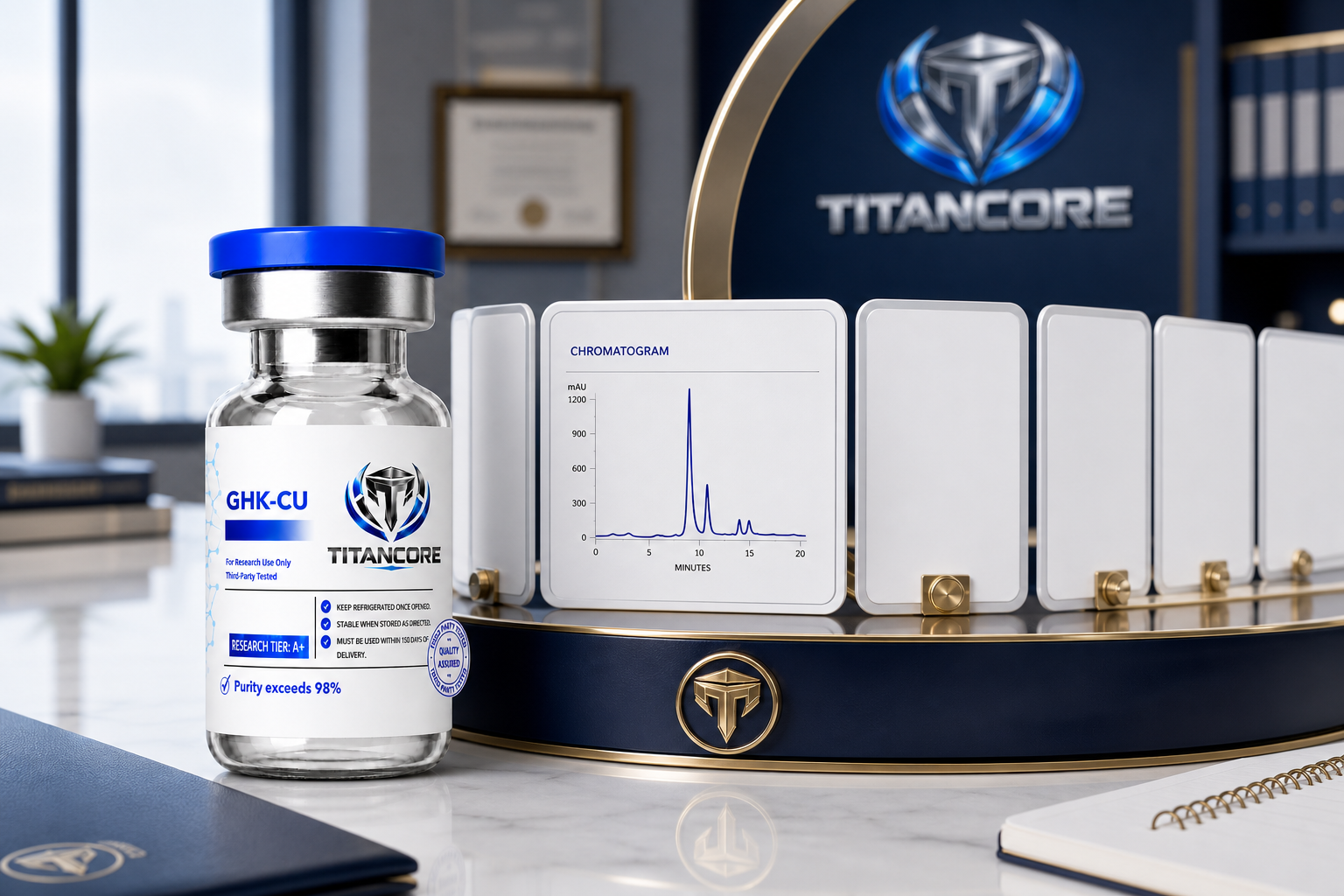
A purity percentage is one of the most visible numbers in peptide marketing. It can be useful. It can also be asked to carry far more meaning than the underlying method supports.
The right question is not only, “What is the percentage?” It is, “Percentage of what, measured how, on which sample, and connected to which lot?”
What the number may represent
In peptide documentation, a purity percentage commonly refers to a chromatographic result under a stated HPLC method. It may describe the proportion of integrated detector response associated with the main peak relative to other integrated peaks.
The exact meaning depends on the method, detector, integration rules, sample preparation and report language. Read the calculation and qualifiers rather than assuming every laboratory reports the number identically.
What it can support
When the report is readable and lot-linked, the result can support a statement such as:
“The laboratory report states a chromatographic purity result of X% for the identified sample under the reported method.”
That wording preserves the sample, method and scope.
What it cannot establish alone
A purity percentage does not automatically establish:
- molecular identity;
- actual fill quantity;
- sterility or endotoxin status;
- residual-solvent profile;
- water content;
- stability across time and storage;
- absence of every possible impurity;
- safety or efficacy; or
- suitability for personal use or a specific experiment.
Other evidence may be needed for those questions.
Why a clean chromatogram still needs context
A chromatogram is produced by a defined system and set of conditions. Peak detection and integration are not context-free. Review retention time, detector, baseline, integration and any method notes provided.
Also ask whether an identity-supporting method, such as mass spectrometry, was performed on the same traceable sample.
Avoid rounding claims upward
If a report states 98.7%, content should not rewrite that as “99%+” or “nearly perfect.” Preserve the reported value, units and qualification. Do not use a threshold from an old lot as a blanket promise for all future inventory.
Titan Core creative should avoid adding invented seals such as “ultra pure” or “guaranteed pharmaceutical grade” unless those precise claims have current legal and documentary support.
Read the rest of the report
Before using the percentage, confirm:
- issuing laboratory;
- sample and lot identifier;
- test and issue date;
- named method;
- chromatogram or data attachment;
- calculation or result field;
- authorization status; and
- any caveat, specification or comment.
The COA reading guide provides a complete walkthrough.
Product evidence is not a health claim
Even a well-supported analytical result should not be converted into a claim about human outcomes. Titan Core's research-only position requires product records, website copy, images and CTAs to point in the same direction.
That means no body transformations, dosing language, injection visuals or medical promises beside a purity number.
A better way to communicate quality
Instead of using one percentage as the entire quality story, present:
- current product and lot;
- readable analytical records;
- method-specific results;
- traceability;
- clear limitations;
- accurate terms; and
- responsive support.
Together, those elements are more credible than a dramatic badge.
Review Titan Core quality standards
Visit Titan Core Quality Standards for current public information and contact Titan Core for lot-specific records.
Sources and further reading
- FDA: Q2(R2) Validation of Analytical Procedures
- NIST: Metrological Traceability
- Related: HPLC vs Mass Spectrometry
For research and analytical-literacy purposes only. A reported percentage must be interpreted within its method and document scope.