
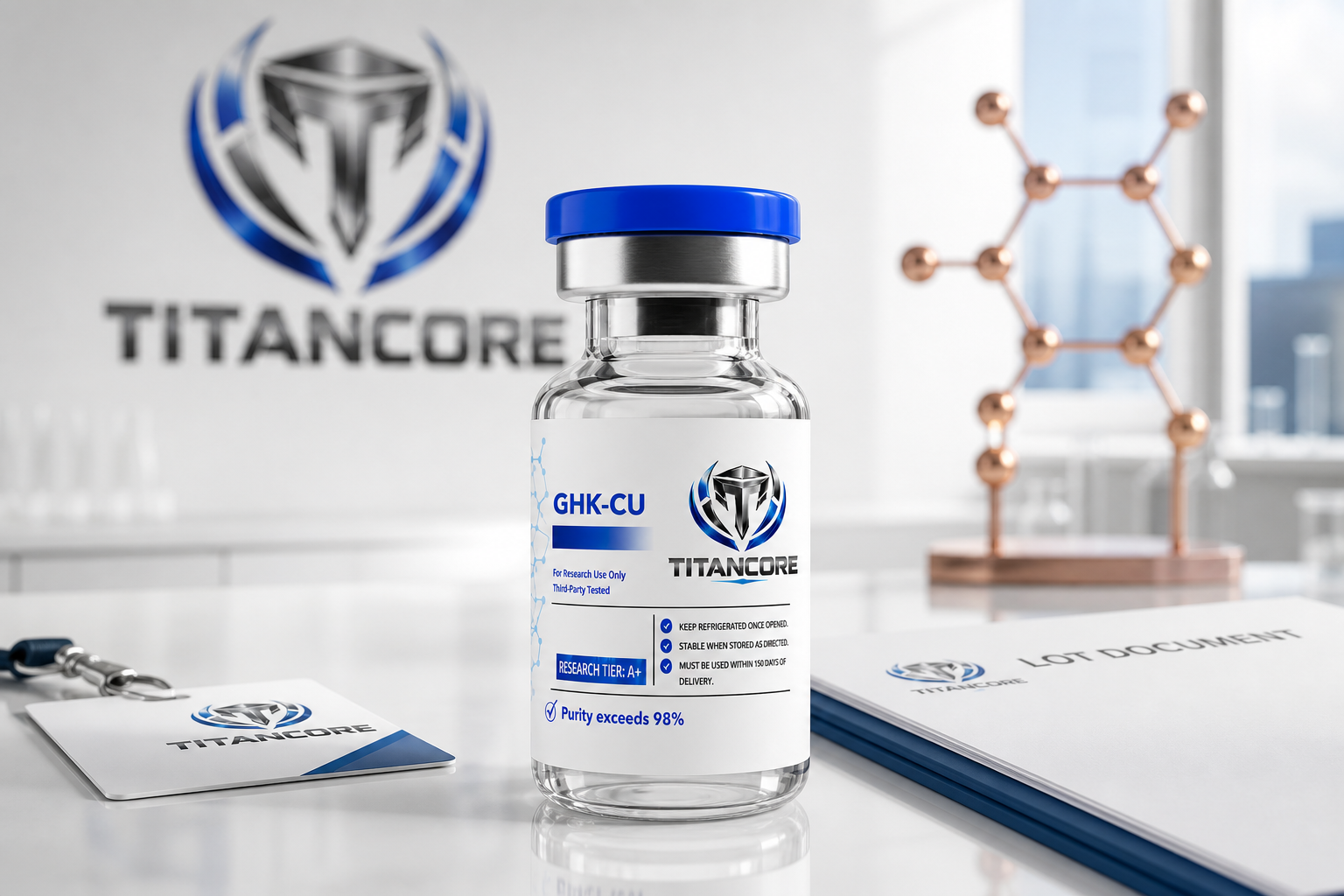
GHK-CU is the copper complex of glycyl-L-histidyl-L-lysine, a three-amino-acid peptide commonly written as GHK. The compound appears in a broad scientific literature, but a useful product review begins by separating three questions:
- What does published research say about the compound?
- What does a supplier claim about a specific product?
- What evidence applies to the exact lot under review?
Keeping those questions separate prevents a scientific reference from becoming an unsupported sales claim.
What published research can establish
A 2016 paper indexed by PubMed examined GHK-CU physicochemical properties for formulation research. The authors used a validated stability-indicating reversed-phase HPLC method, assessed stress conditions and used HPLC with mass spectrometry to identify degradation products.
This study is useful for understanding why researchers may care about identity, method scope, stability conditions and degradation. It does not test or verify a Titan Core product.
Other published studies have explored GHK-CU in cell and animal models. Those findings belong to their stated experimental systems. They should not be rewritten as promises about a supplier product or a human outcome.
What the Titan Core product page should establish
The intended Titan Core GHK-CU page should give a qualified buyer current product-level facts:
- product name and format;
- catalog or SKU identifier;
- current availability;
- lot or batch identifier;
- current documentation links and status;
- handling and storage language supported by the product record;
- research-only terms; and
- an official support route.
The live homepage currently shows a GHK-CU product card and official product image. At audit time, the product URL redirected to the homepage. The article should be released only after that route opens the correct page.
Why identity and purity are different questions
Chromatographic and mass-spectrometric records can be complementary, but they should not be treated as interchangeable badges.
- An HPLC record may report chromatographic purity under the stated method and calculation.
- A mass-spectrometry record may support identity by comparing an observed mass with an expected mass.
- Neither label alone proves sterility, endotoxin status, safety, efficacy, quantity or human suitability.
Read HPLC vs mass spectrometry for the full method comparison.
The lot connection matters
A clean product image tells a buyer what the brand intends to sell. The lot identifier and current document tell the buyer which record applies to the material being evaluated.
Before relying on a certificate, reconcile:
- product name;
- lot or batch number;
- document ID;
- laboratory and dates;
- method and result; and
- current status.
If the certificate is only a sample or belongs to a different lot, it may be useful as a format example but not as current evidence.
Handling language should be product-specific
Peptide stability can depend on form, temperature, moisture, light, container, time and the actual study conditions. A general online rule should not replace the supplier's current product documentation or a qualified protocol.
For GHK-CU, use the handling language tied to the exact product and lot. Do not infer instructions from a paper studying a different formulation, concentration or delivery system.
A responsible GHK-CU review
Use this short sequence:
- Confirm the intended research context.
- Open the correct product page.
- Record product identity and format.
- Review current lot and document status.
- Read each analytical method within its scope.
- Route unresolved questions to Titan Core support.
- Preserve the product, lot and document connection in the purchase record.
The companion article Ten questions to ask before procuring GHK-CU turns this sequence into a buyer checklist.
View GHK-CU
After route repair and current-document QA, visit the intended Titan Core GHK-CU product page. For availability or documentation questions, use the official Contact page.
Sources and further reading
- PubMed: Physicochemical characterization of GHK-CU
- PubMed: GHK-CU and connective-tissue accumulation in a rat wound model
- Related: How to read a peptide COA
- Related: Labels, lots and traceability
For research and laboratory context only. This article does not provide medical, cosmetic, therapeutic, dosage or administration guidance.